Shop
SHOP-IT
COMPRE COM FACILIDADE /BUY WITH EASE
View productInternational edition
Markets · Politics · History
 Mente forte, finanças inteligentes
An independent perspective
Shop
COMPRE COM FACILIDADE /BUY WITH EASE
View product
Shop
COMPRE AQUI
View productEvery boom feels different from the inside. Four centuries of bubbles, from Dutch tulips to crypto tokens, show the same pattern and the same warning signs.
By Psycho of Finance
Published by Psycho of Finance

Every generation believes its boom is different. The record suggests otherwise. From Dutch tulip bulbs in the 1630s to crypto tokens in the 2020s, financial bubbles share a recognizable shape: a real innovation, easy credit, rising prices that attract new buyers, and a story that explains why the old rules no longer apply. Knowing the pattern does not let you time the top, but it can keep you from being swept along.
In the Dutch Republic in the 1630s, prices for rare tulip bulbs, including contracts to buy them in the future, rose sharply and then collapsed in early 1637. Historians still debate how large the episode really was, and some research suggests the damage to the wider Dutch economy was smaller than the legend says. What survives is the lesson: when people buy something mainly because they expect to sell it for more, price detaches from use.
In 1720 two schemes inflated and burst almost together. In Britain, shares of the South Sea Company, tied to government debt and promised trade profits, rose several times over in a matter of months before collapsing. In France, John Law's Mississippi Company followed a similar arc. Isaac Newton is widely reported to have lost a large sum in the South Sea episode, a reminder that intelligence does not protect against crowd psychology.
In 1840s Britain, a real technology drew a wave of speculative share issues. Railways were built and transformed the economy, yet many investors lost money because they paid far too much. A bubble can be built on something genuinely important. Being right about the technology did not mean being right about the price.
In the United States, stocks rose through the 1920s, helped by new industries and by buying on margin, meaning with borrowed money. The Dow Jones Industrial Average peaked in September 1929 and by July 1932 had lost close to 90 percent of its value. It did not regain its 1929 high until 1954.
Japan's Nikkei 225 peaked at the end of 1989 after a boom in stocks and real estate fueled by cheap credit. It then slid for years, and the index only surpassed its 1989 record in early 2024, more than three decades later.
Between the mid-1990s and March 2000, internet stocks soared on the belief that traffic mattered more than profit. The Nasdaq Composite peaked in March 2000 and then fell roughly 78 percent by October 2002. Some survivors of that era became giants, which shows that a bubble can be both a mania and a real technological shift.
Rising US house prices, loose lending standards and complex mortgage securities created a bubble in housing credit. When prices fell and defaults grew, the stress spread through banks worldwide. The S&P 500 fell roughly 57 percent from its October 2007 peak to its March 2009 low.
Bitcoin rose to close to 20,000 dollars in December 2017 and fell more than 80 percent over the following year. It reached a peak near 69,000 dollars in November 2021 and fell by about three quarters by late 2022, as the failure of the FTX exchange showed how fragile trust can be. The details of the latest cycle are covered in our guide to the Bitcoin halving and ETFs.
Economists such as Hyman Minsky and Charles Kindleberger described a recurring sequence that fits most of the episodes above.
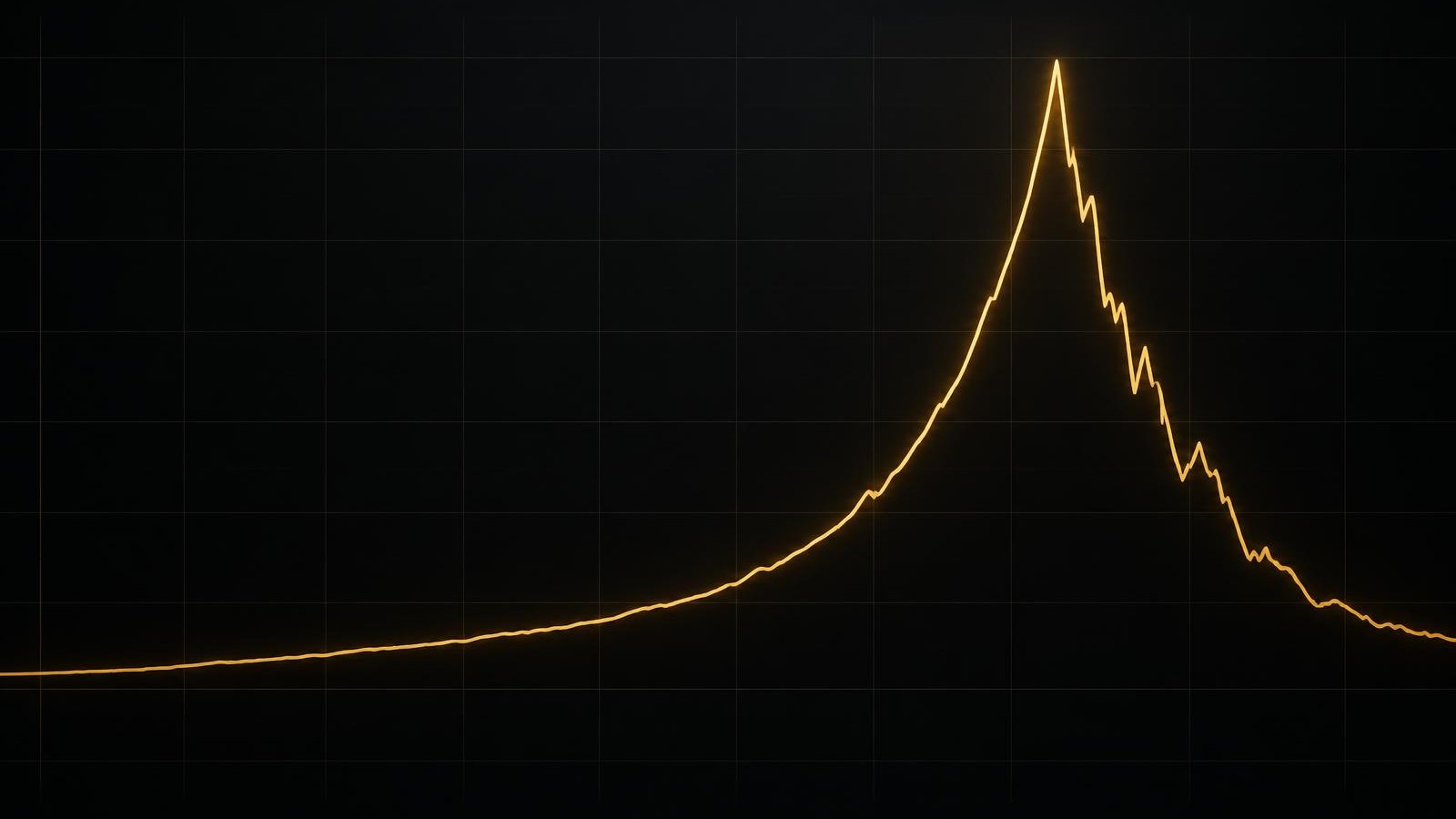
Cheap money is present in most of these stories, which is why interest rates matter so much to the whole cycle.
Bubbles are not a flaw in one asset. They are a recurring feature of markets because people, credit and good stories repeat. You cannot reliably call the top, but you can size your risk so that a burst does not decide your future.
This article is educational and is not financial advice.
In 1944, delegates from 44 nations rebuilt the world's money around the US dollar. Here is how Bretton Woods worked, why it broke down and what it left behind.
A confused announcement on live television opened the most famous border of the Cold War in a single evening. Here is how it happened and what came next.
The mechanics of 1929 — leverage, concentration, and policy paralysis — rhyme uncomfortably with 2026.